
Imagine a board makes a big decision, such as selling the building the organization has operated from for twenty years. The meeting is long, the vote is clear, and everyone leaves confident. Then time passes. Directors rotate off, the executive director moves on, and the board makes dozens of other decisions. Years later, a donor, a new director, or the Attorney General asks why the board did it that way. Could the board recreate that decision, including what it knew, what it weighed, who authorized it, and why it chose that path? For many boards, the honest answer is no.
Chapter 180 says less about board governance than most directors assume, and the Attorney General expects more than the statute does. This article separates what the law requires from what is only good practice.
The short answer
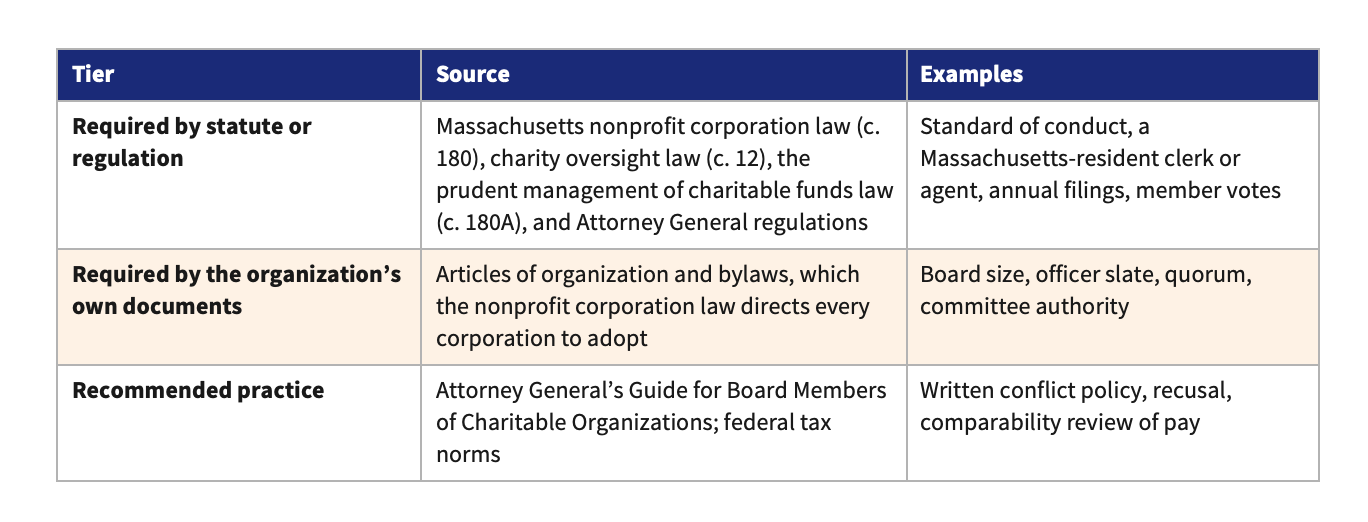
Massachusetts puts a short list of mandatory duties on the board of a charity organized under M.G.L. c. 180. The law sets a standard of conduct. It requires a clerk who lives in Massachusetts, or a resident agent. It requires the bylaws to cover certain topics. It requires annual filings with the Attorney General and the Secretary of the Commonwealth. And it requires a member vote and, in some cases, notice to the Attorney General, for major transactions. Everything else a board does comes from its own articles and bylaws, Attorney General guidance, and federal tax norms.
But many boards assume that a practice no statute requires is optional. It is not. The Attorney General enforces the fiduciary standard (M.G.L. c. 12, § 8), and a board that cannot show how it reached a decision will have a hard time defending it.
The table below sorts the requirements into three tiers.
See our other posts on the related topics of fiduciary duties, conflicts of interest, and setting executive pay.
The standard of conduct: M.G.L. c. 180, § 6C
Section 6C is the heart of Massachusetts charity board law. It writes the duty of care into the statute. It does not spell out the duties of loyalty or obedience.
Under § 6C, every director, officer, and incorporator (a person who formed the corporation) must carry out his or her duties, including committee work, in good faith, in a way reasonably believed to be in the best interests of the corporation, and with the care an ordinarily prudent person in a similar position at a similar charity would use in similar circumstances.
The statute also protects reasonable reliance. A director may rely on information, reports, and financial records prepared by officers or employees the director reasonably believes are reliable and competent; on advice from lawyers, accountants, or others on matters within their expertise; and on a properly formed board committee the director does not serve on. That reliance does not count as good faith if the director knows something that makes it unwarranted. A director, officer, or incorporator who meets the § 6C standard is not liable for how he or she performed those duties.
Three duties, three sources
Care (written into the statute). Section 6C sets the standard, protects reasonable reliance, and shields people who meet the standard from liability.
Loyalty (from court decisions). Section 6C speaks to good faith and the corporation’s best interests, but it does not define conflicts of interest or self-dealing. In Squeri v. Mount Ida College, 954 F.3d 56, 67 (1st Cir. 2020), the First Circuit quoted American Discount Corp. v. Kaitz, 348 Mass. 706 (1965), for the principle that a director’s duty runs to the corporation “above every other obligation.” But Squeri itself ties a charity director’s fiduciary duty to § 6C and declines to add duties the statute does not impose, so a board should not assume that courts will enforce a loyalty duty separate from § 6C.
Obedience (from court decisions, not the statute). Chapter 180 does not set out a separate duty of obedience, and the Attorney General’s Guide names only care and loyalty. The closest authority is a line of cases requiring charity boards to stay true to the charity’s purposes and protect charitable assets, discussed below.
How courts have treated the standard
Our understanding of § 6C comes from lower and federal courts and from an older Supreme Judicial Court (SJC) case that predates the statute. A board should plan for both a business-style standard and a stricter one.
Boston Athletic Ass’n v. International Marathons, Inc., 392 Mass. 356 (1984). This case predates § 6C and dealt with delegation. The SJC held that a board cannot give an officer such broad authority that the officer can commit the corporation to extraordinary obligations. It read the authority of charity officers more narrowly than that of business officers, and it said that people who manage charitable funds “owe an especially high degree of accountability to the individual donors as well as to the community.” Id. at 363–66.
First Bostonview Management, LLC v. Bostonview Corp., 88 Mass. App. Ct. 89 (2015). The Appeals Court described charity boards and officers as subject to strict fiduciary standards. It also held that approving or ratifying an extraordinary transaction after the fact does not substitute for specific authorization beforehand.
Squeri v. Mount Ida College (1st Cir. 2020). Applying Massachusetts law, the First Circuit held that a charity director’s fiduciary duty comes from § 6C and is owed to the college, not to its students, and that courts may not add fiduciary duties the statute does not impose. This is a federal court’s prediction of Massachusetts law, not an SJC holding.
No binding appellate decision has settled whether § 6C replaces the stricter accountability language in Boston Athletic Ass’n. A prudent board keeps a record of its process and takes extra care with decisions that touch charitable assets, purposes, or extraordinary transactions.
Structure and mechanics: what the statute requires and what your bylaws must cover
Chapter 180 is the scaffolding. It leaves most board mechanics to the articles and bylaws, so start by reading the bylaws against the few statutory mandates.
Board size and officers
Board size. Massachusetts law sets no minimum number of directors and leaves board size to the bylaws. Many charities set a minimum in their bylaws anyway.
Officers. The bylaws must set out the titles, duties, powers, terms, election, and removal of officers. A charity may use presiding, financial, and recording officers in place of a president, treasurer, and clerk.
Resident clerk or agent. This is the one direct statutory qualification. The clerk must live in Massachusetts unless the corporation has appointed a resident agent.
Meetings, quorum, and committees
Member meetings. If a corporation has members, the bylaws set the quorum and meeting procedures. The statute sets one floor: the clerk must call a special meeting when members representing at least ten percent of the smallest quorum needed for an annual-meeting vote ask in writing. Since March 31, 2023, the board may authorize in-person, remote, or hybrid member meetings unless the articles or bylaws say otherwise.
Memberless corporations. A corporation with no members acts through its directors. Any vote the law requires of members is taken by the same percentage of the directors.
Director meeting rules come from the business corporation statute, M.G.L. c. 156B, which applies to charities unless chapter 180 says otherwise. Each of the following defaults gives way to a contrary bylaw.
Quorum. Unless the bylaws say otherwise, a majority of the directors in office is a quorum, and a majority of those present may act unless a larger number is required.
Notice. Regular meetings may be held without notice if the bylaws or the board fix their time and place. Special meetings require notice. The bylaws may define proper notice, and a written waiver, or attending without objecting, cures defective notice.
Action without a meeting. Unless the articles or bylaws say otherwise, directors may act without a meeting only if every director consents in writing and the consents are filed with the meeting records. Joining by conference call or similar means counts as attending in person.
Committees. A board may use committees only if the articles or bylaws allow them. Among other limits, a committee cannot amend the bylaws, change the size of the board, fill board vacancies, or remove officers or directors.
Bylaws and records
Amending bylaws. A charity amends its bylaws using the business corporation procedure, with members taking the place of stockholders. An amendment also requires notice at a previous meeting and does not take effect until the Secretary of the Commonwealth approves it as conformable to law.
Records. Chapter 180 has no general records section. It does require the bylaws to address custody and investment of funds and a periodic audit of the treasurer’s accounts, and a member may request a copy of the bylaws in writing. Attorney General regulations require permanent books and records that back up every item in the annual report, and charity law requires true fiscal records, kept at least three years, to be available to the Attorney General’s Division of Public Charities on demand (940 CMR 2.03; M.G.L. c. 12, § 8L). The general business corporation records statute does not govern charities.
Minutes. No statute dictates the form of minutes, and the Attorney General’s Guide does not address minute-taking. Boards should still record the information they considered and their reasons for each significant decision, because the § 6C standard is tested on process.
Conflicts of interest, related-party transactions, and compensation
No Massachusetts statute prescribes a conflict-of-interest procedure or a compensation review process for a charity. What the law does require is the § 6C standard, annual disclosure to the Attorney General, and recordkeeping. Everything else is recommended practice.
Business corporations get a statutory safe harbor for director conflicts. Charities get none. A conflicted transaction is tested against § 6C and the common-law duty of loyalty, and the Attorney General polices it through Form PC disclosure and enforcement. Massachusetts also has no statute that bars or limits loans to, or transactions with, charity insiders. The statutory mandate is disclosure and records.
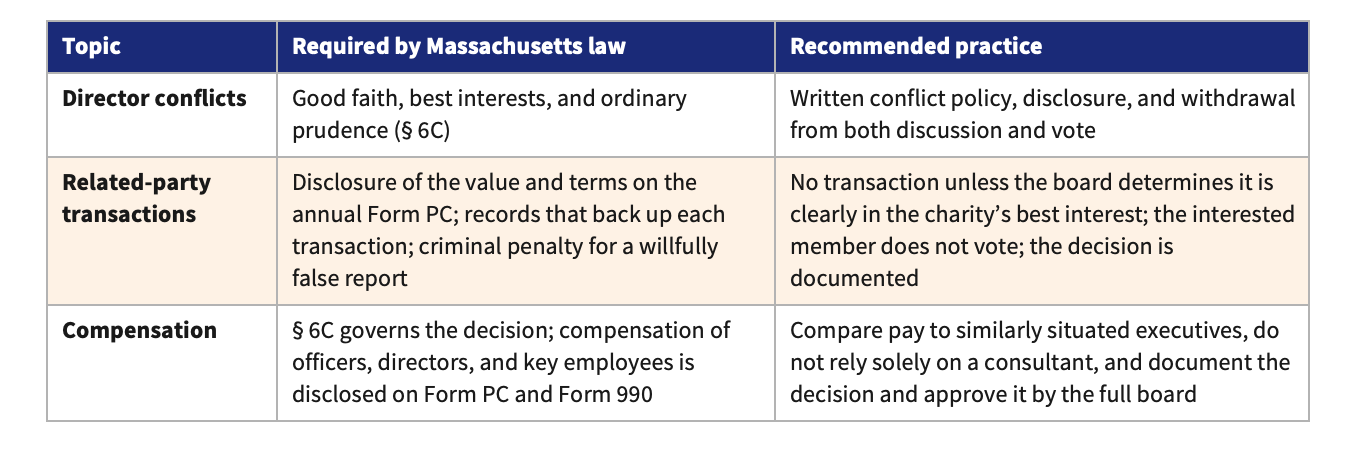
The most familiar compensation process comes from federal law, not Massachusetts law. Under the IRS intermediate sanctions rules, pay gets a “rebuttable presumption” of reasonableness if disinterested decision-makers approve it, they rely on comparability data, and the decision is documented at the time.
Financial oversight and annual filings
A Massachusetts charity makes three annual filings, two with the state and one federal. The board should review each one before an officer signs it.
Form PC (Attorney General)
The governing board of every public charity must file an annual report with the Attorney General’s Division of Public Charities (M.G.L. c. 12, § 8F). An authorized officer signs the report and verifies it under oath. The Attorney General, not the statute, sets the due date. The Attorney General’s instructions have stated it as four and one-half months after the fiscal year ends, with extensions available.
A charity that willfully files a materially false report faces a fine of up to $5,000, imprisonment of up to one year, or both.
The financial statement a charity must attach depends on its gross support and revenue for the fiscal year, not counting gains or losses from selling a capital asset.
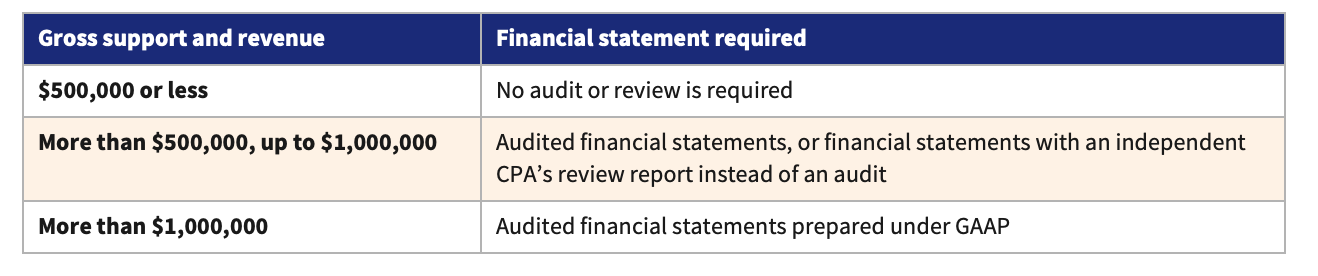
The Division requires statements that are complete and final, with a signed CPA opinion letter. It does not accept drafts or compilations. These thresholds took effect November 20, 2024 (St. 2024, c. 238, §§ 12, 13). The Attorney General’s regulation still lists an older $100,000 audit threshold, but the statute and the Attorney General’s current guidance control.
The Form PC filing fee is graduated by gross support and revenue (from $35 for revenues below $100,000 up to $2,000 for revenues exceeding $100 million).
Secretary of the Commonwealth annual report
Every covered charity must file a certificate with the Secretary of the Commonwealth on or before November 1 each year, signed by an officer under the penalties of perjury (M.G.L. c. 180, § 26A). It states the corporation’s name, the address of its principal office, the date of its last annual meeting, and the names, addresses, and term expirations of all officers and directors. The fee is set annually. A corporation that fails to file for two successive years receives mailed notice, and if it does not cure within 90 days, the Secretary has sufficient cause to revoke its charter.
Form 990 (federal)
Federal law requires most tax-exempt organizations to file an annual return, Form 990, with limited exceptions. Massachusetts does not require a separate return, but the federal Form 990 must be attached to the Form PC.
Managing charitable funds under M.G.L. c. 180A
Chapter 180A, the Massachusetts version of the Uniform Prudent Management of Institutional Funds Act, applies a prudence standard to investing and spending charitable funds. It took effect July 2, 2009. It has no express recordkeeping requirement.
Investing. Anyone responsible for an institutional fund must manage and invest it in good faith and with ordinary prudence, consider the charitable purposes of the institution and the fund, and weigh the relevant factors: economic conditions, inflation or deflation, tax consequences, each investment’s role in the portfolio, expected total return, other resources, the need to make distributions and preserve capital, and an asset’s special relationship or value to the charitable purposes. The standard also calls for reasonable costs, decisions made in the context of the whole portfolio, diversification unless special circumstances justify otherwise, and review and rebalancing within a reasonable time.
Spending. Subject to donor intent, an institution may spend or save as much of an endowment fund as it prudently decides, acting in good faith and with ordinary prudence and weighing seven factors: duration and preservation of the fund, the purposes of the institution and the fund, economic conditions, inflation or deflation, expected total return, other resources, and the institution’s investment policy. Massachusetts eliminated the historic dollar value floor (the old rule that kept an endowment from dropping below the value of the original gifts) and did not adopt the optional presumption that spending more than seven percent is imprudent.
Delegation. An institution may hand management to an outside agent to the extent it could prudently do so, but it must use care in choosing the agent, setting the scope and terms of the delegation, and periodically reviewing the agent’s work. An institution that does so is not liable for the agent’s decisions.
Releasing or modifying restrictions. With the donor’s documented consent, an institution may release or modify a restriction, but never to allow a non-charitable use. A court may modify a restriction or apply cy pres (redirecting the gift to a purpose as close as possible to the donor’s original intent), and the Attorney General must be made a party. Under M.G.L. c. 180A, § 5(d) and S.J.C. Rule 1:23, a fund of $75,000 or less that is at least 20 years old may be modified with the Attorney General’s consent, without going to court.
The statute does not require documentation. Still, a prudence decision is judged by the factors the board considered, so contemporaneous records of the spending and investment factors, and of any decision not to diversify, are how a board shows it complied.
Actions that require a member vote or Attorney General involvement
Four fundamental actions have their own statutory procedures. Three require a two-thirds vote of the members entitled to vote. Dissolution requires a majority of the board. Attorney General involvement depends on the action.
Sale, lease, or exchange of all or substantially all assets (M.G.L. c. 180, § 8A). Vote: Two-thirds of members at a properly noticed meeting. No vote is required if there is no material change in the nature of the activities. Attorney General: Written notice at least 30 days before a disposition that involves a material change in activities, unless the Attorney General grants a waiver. Nonprofit acute-care hospitals and HMOs disposing of a substantial amount of assets or operations to anyone other than a public charity: 90 days, Attorney General investigation and public hearing, and court review of the governance of any resulting charitable fund. Filing or court: Officer’s certificate of notice, waiver, or inapplicability is conclusive for a purchaser.
Merger or consolidation (M.G.L. c. 180, §§ 10, 10A). Vote: Two-thirds of the members of each constituent corporation. Attorney General: The merger statute has no express notice requirement. Attorney General oversight reaches a merger through § 8A and the Attorney General’s general enforcement power (c. 12, § 8). Filing or court: Articles of merger filed with the Secretary of the Commonwealth. If any merging corporation is a public charity, the survivor is a public charity.
Amendment or restatement of articles (M.G.L. c. 180, § 7). Vote: Two-thirds of members at a properly noticed meeting. Attorney General: None generally. Filing or court: Articles of amendment or restated articles filed with the Secretary of the Commonwealth. Any required agency approval of a change in purposes comes first.
Voluntary dissolution (M.G.L. c. 180, § 11A). Vote: Majority of the board, or of the members if the governing documents so provide. Attorney General: If no assets remain, the Division of Public Charities must approve. If assets remain, the dissolution proceeds by petition to the SJC. Filing or court: Petition to the SJC to direct the remaining assets to a similar charitable purpose (cy pres).
A corporation with no members takes any member vote by the same percentage of its directors. Authorization also has to come first. Under Boston Athletic Ass’n and First Bostonview, a charity is bound to an extraordinary transaction only by prior specific authorization, and later approval or ratification does not substitute.
Enforcement and personal liability
The Attorney General is the primary enforcer, private plaintiffs rarely have standing, and several statutes limit a volunteer director’s personal exposure.
What the Attorney General can do
Enforce the proper use of charitable funds and prevent breaches of trust (M.G.L. c. 12, § 8).
Require registration before a charity does charitable work or raises funds in the Commonwealth. The president and treasurer are presumed, unless shown otherwise, to have authority to make sure the charity complies.
Require the annual Form PC and, if a charity fails to file, sue to stop it from doing business in the Commonwealth or take other action to compel compliance.
Assess a civil penalty of up to $50 per day, capped at $10,000, against the charity or, instead, against a responsible officer or agent who had authority to cause compliance and neglected or refused. The charity cannot indemnify or reimburse that person for the penalty.
Inspect fiscal records on demand and be made a party to related court proceedings.
Who else can sue
Only the Attorney General can sue over misuse of charitable assets. Weaver v. Wood, 425 Mass. 270 (1997). The SJC has described the Attorney General as the only person, other than a trustee, with standing to sue on behalf of the public a charity serves. DeGiacomo v. City of Quincy, 476 Mass. 38 (2016). A private plaintiff can sue only to protect an individual interest distinct from the public’s, such as a denied membership or voting right. Lopez v. Medford Community Center, Inc., 384 Mass. 163 (1981). Being a member is not enough on its own.
Limits on personal liability
Statutory standard. No liability for the performance of duties if the director, officer, or incorporator complies with the § 6C standard, including its reliance protections. Exceptions: Lost if the standard is not met, or if the person knew facts that made reliance unwarranted.
Volunteer immunity. No civil liability for acts or omissions relating solely to the duties of an officer, director, or trustee of a charitable nonprofit who serves without compensation above $500 per year, apart from expense reimbursement. Exceptions: Acts intended to harm, grossly negligent acts that result in harm, primarily commercial activities, and operation of an automobile.
Indemnification. Permitted to the extent the articles, a bylaw adopted by the incorporators or members, or a majority member vote provides. Exceptions: Permissive only. A § 8F civil penalty cannot be indemnified.
Educational institution directors. An uncompensated director, officer, or trustee of a 501(c)(3) educational institution is not liable solely by reason of those services if acting in good faith within the scope of official duties. Exceptions: Willful or wanton misconduct and operation of a motor vehicle.
Cap on the charity’s own tort liability. Charitable status is no defense to a tort claim, but liability for a tort committed while directly carrying out charitable purposes is capped at $20,000. A separate $100,000 cap applies to medical malpractice claims against nonprofit health care providers. Exceptions: Activities primarily commercial in character. The cap protects the organization, not individual directors.
What a Massachusetts board should do
Read the bylaws against the statute once a year. Confirm that they cover the topics the statute requires (officers, quorum, special meetings, custody of funds, the treasurer’s audit, and amendment). Say whether the business corporation defaults on director quorum, written consent, and committees apply or have been replaced. And confirm that the clerk lives in Massachusetts or that the corporation has a resident agent.
Calendar the three filings and review each before it is signed. The Attorney General’s instructions put the Form PC due date at four and one-half months after year-end, unless extended. The Secretary of the Commonwealth certificate is due on or before November 1 unless the corporation is exempt. The Form 990 follows federal deadlines. An officer verifies the Form PC under oath, and a willfully false filing is a crime, so the board should review it first.
Match the financial statement to revenue. Above $500,000, engage the CPA early. Above $1,000,000, an audit is required. The Division does not accept drafts or compilations.
Adopt a written conflict policy and follow it. Require disclosure, withdrawal from discussion and vote, and a documented best-interest finding for any related-party transaction, and record the comparability data and reasoning behind executive pay.
Authorize before acting. Get specific authorization before any extraordinary transaction. Confirm the member vote and Attorney General notice before an asset sale, merger, amendment, or dissolution. Document spending and investment decisions and the periodic review of any outside investment manager.
Conclusion
Go back to that big decision, the one the board made years ago and has since buried under a hundred others. If someone asked tomorrow why the board did it that way, what could you hand them? Chapter 180 does not require minutes, a conflict policy, or a pay comparison, but those records are what let a board answer. A board that can reconstruct its reasoning can defend it. A board that cannot has only its memory, and memory fades as directors rotate off.
So try this with your own board. Pick the biggest decision it made in the last few years. Could you recreate it today from your minutes and bylaws, including who authorized it, what the board considered, and why it chose the path it did?
Looking for the analogous rules for DC nonprofits?
About the author
Alex Booker is the Managing Partner of Commonlight Legal LLP, a boutique law firm serving nonprofits in Massachusetts, Washington DC, New York, and Connecticut. He advises nonprofit boards and executive directors on employment law, governance, and compliance.
Before founding Commonlight, Alex served as an Attorney Advisor at the U.S. Department of Education's Office of General Counsel, adjudicated federal employment cases at the U.S. Merit Systems Protection Board, and litigated whistleblower and civil rights matters on behalf of employees at a DC plaintiff-side employment firm. Earlier in his career, he served as Research Director for a Massachusetts Joint Legislative Committee. Alex is admitted to practice in Massachusetts and Washington, DC.
This article is for general informational purposes only and does not constitute legal advice. Reading this article does not create an attorney-client relationship. For advice specific to your organization's situation, contact Commonlight Legal LLP.