
DC Nonprofit Board Governance: What the Law Requires
Governance rules can look like housekeeping – something to address in the bylaws, minutes, or next filing. Under DC law, some of those details determine whether the board can act at all. A vote may fail because a director did not receive notice. A written consent may fail because one signature is missing. A lapse in a filing or insurance coverage may expose the organization and its directors to consequences that cannot be fixed after a dispute begins. The key is knowing which rules the board may customize and which ones it must follow.
The Short Version
The DC Nonprofit Corporation Act of 2010 creates two layers of governance rules. D.C. Code § 29-401.01 et seq. The first is a short list of mandatory rules that the bylaws cannot change. The second is a much larger set of default rules that the articles or bylaws may override. Problems arise under the first layer when a board has fewer than three directors, acts without proper notice, loses its minutes, lends money to an officer, or lets the biennial report lapse. Problems arise under the second when the board fails to follow its own bylaws.
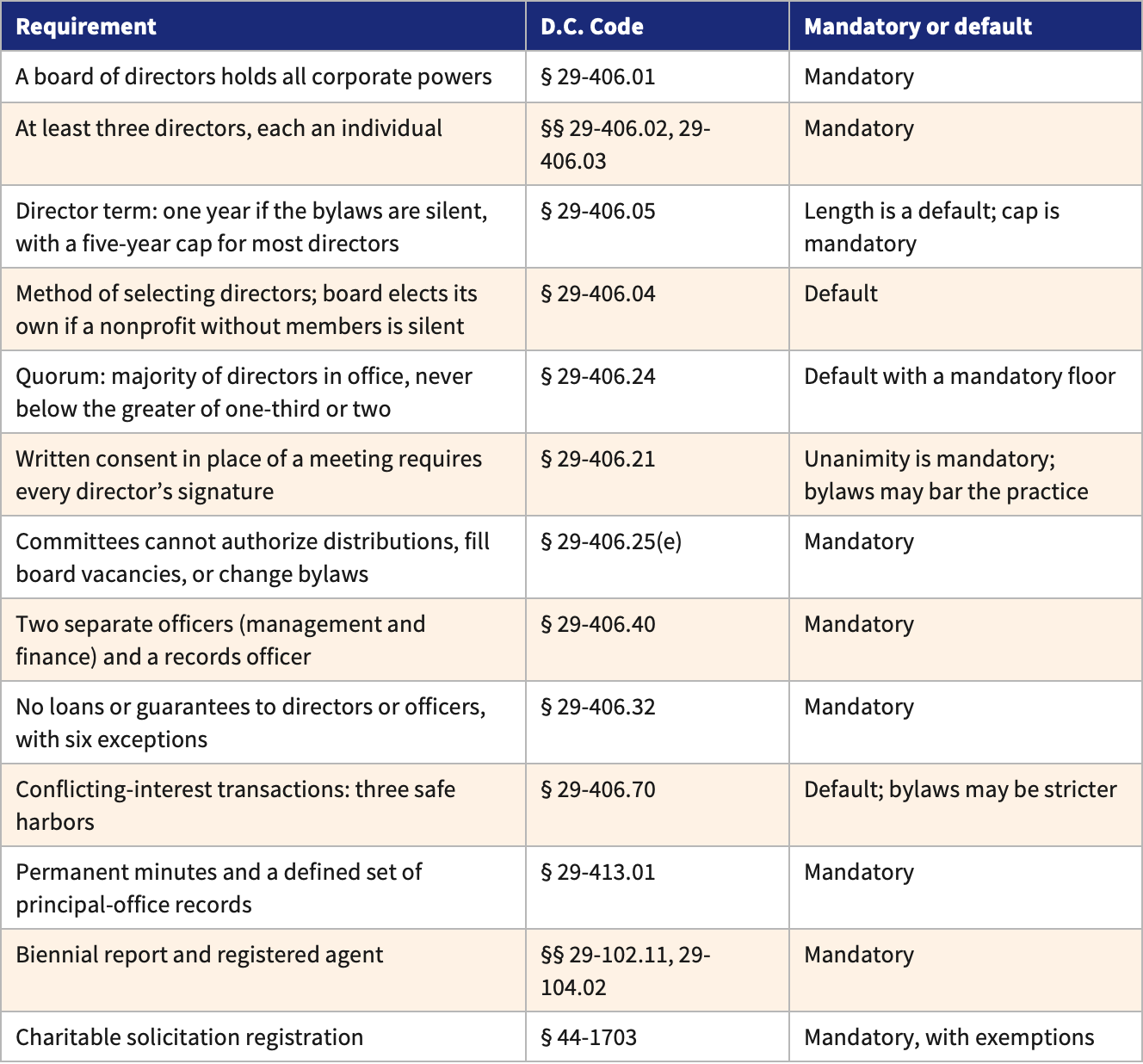
This article addresses DC law only. For a broader discussion of directors’ duties, see our guide to nonprofit board fiduciary duties. The table below provides a quick map of the rules discussed in the article.
DC statutory map (jurisdiction: DC)
Who Sits on the Board
A DC nonprofit must have at least three directors, and each director must be an individual. D.C. Code §§ 29-406.02, 29-406.03. The bylaws cannot reduce that minimum. They may impose additional qualifications, such as residency or membership requirements. Unless they do, a director does not need to live in DC.
Terms. If the bylaws are silent, a director serves a one-year term. The Act caps most terms at five years, but that cap does not apply to directors appointed by non-members or designated through a method other than election or appointment. § 29-406.05. Unless the bylaws provide otherwise, a director remains in office after the term ends until a successor takes office.
Selection. For a nonprofit without members, the articles or bylaws control how directors are selected. If both are silent, the board elects its own directors. § 29-406.04(b). Because many nonprofits have no members, this self-perpetuating structure is common.
Removal. The board of a nonprofit without members may remove a director with or without cause unless the bylaws require cause. § 29-406.08(b). The board of any DC nonprofit may also remove a director on specified grounds. Those grounds include a final court order declaring the director of unsound mind, a felony conviction, a final court order finding that the director breached a duty, the number of missed meetings specified in the bylaws at the start of the term, or the director’s failure to continue meeting a bylaw qualification. § 29-406.08(c). A director designated in the bylaws may be removed only by amending that designation. § 29-406.08(d). The Superior Court may remove and bar the reelection of a director who committed fraud, grossly abused the position, or intentionally harmed the corporation. If the nonprofit is a charitable corporation, the plaintiff must notify the Attorney General. § 29-406.09.
Vacancies. Unless the bylaws provide otherwise, the remaining directors may fill a vacancy even if they are fewer than a quorum. § 29-406.10. Vacancies in seats filled by appointment or designation follow the rules for those seats. A committee may not fill a board vacancy. § 29-406.25(e).
How the Board Acts
Board action is valid only if the board follows the applicable notice, quorum, and voting rules. DC courts have invalidated action when a director did not receive required notice. Because most of these rules are defaults, the bylaws are the first place to look.
Meetings and notice. Unless the bylaws say otherwise, a special meeting requires at least two days’ notice of the date, time, and place, and the notice need not state the purpose. § 29-406.22(b). The board chair, the highest-ranking officer, or 20 percent of the directors then in office may call a meeting. § 29-406.22(c). A corporation may give one notice at the start of the year covering all regularly scheduled meetings. § 29-406.22(a). Directors may participate remotely by any means that lets everyone hear each other simultaneously, unless the bylaws restrict it. § 29-406.20(b). An email thread likely does not meet that standard.
Waiver. A director waives notice by attending, unless the director objects at the start of the meeting or promptly on arrival and does not later vote for the action. § 29-406.23(b). A signed written waiver is also effective if it is filed with the minutes. § 29-406.23(a).
Quorum and voting. The default quorum is a majority of the directors in office before the meeting begins. The bylaws may lower it, but never below the greater of one-third of the directors in office or two directors. § 29-406.24(a) and (b). If a quorum is present, a majority of the directors present decides the vote unless the bylaws require more. § 29-406.24(c).
Recording dissent. A director who is present when the board acts is generally treated as having assented. To avoid that result, the director must object at the outset or dissent or abstain and have that position recorded in the minutes. The director may instead deliver written notice to the presiding officer before adjournment or to the corporation promptly afterward. § 29-406.24(d). A director who votes in favor cannot later claim dissent. § 29-406.24(e).
Action without a meeting. The board may act by written consent only if every director signs. The bylaws can bar the practice, but they cannot authorize consent by fewer than all directors. § 29-406.21.
Committees. A committee may exercise board powers only to the extent specified by the board or the bylaws. It may not authorize distributions, fill board vacancies, or adopt, amend, or repeal bylaws. § 29-406.25(d) and (e). The meeting, notice, and quorum rules apply to committees. § 29-406.25(c). Creating a committee does not by itself satisfy a director’s own standard of conduct. § 29-406.25(f).
What a defect costs
In Jackson v. George, 146 A.3d 405 (D.C. 2016), one trustee did not receive the required prior written notice. The Court of Appeals upheld the invalidation of the resulting board resolution and treated later votes by the improperly installed board, including a merger, as invalid, too. By contrast, Re’ese Adbarat Debre Selam Kidest Mariam Ethiopian Orthodox Tewahedo Church, Inc. v. Habte, 300 A.3d 784 (D.C. 2023), involved an annual meeting held outside the month fixed by the bylaws. Relying on D.C. Code § 29-405.01(d), the court refused to invalidate the action on that basis alone. Read together, the two cases suggest that shutting a director out of notice or participation invalidates board action, while a scheduling slip does not.
Who Runs the Corporation
A DC nonprofit must have at least two separate officers: one responsible for management and one responsible for financial affairs. The articles, bylaws, or board must also assign an officer to prepare the minutes and maintain the required records. D.C. Code § 29-406.40(a) and (b). The titles are flexible. “President” and “Treasurer” are examples, and no office has to be called Secretary. One person may hold more than one office, but the two required roles call for separate individuals.
An officer’s authority comes from the articles, the bylaws, or duties the board prescribes consistent with them. § 29-406.41. When a contract is challenged, DC courts ask whether the officer had actual or apparent authority, and the corporation bears the burden of showing the officer lacked it. Green Leaves Rest., Inc. v. 617 H St. Assocs., 974 A.2d 222 (D.C. 2009). A board that never wrote down limits on who may sign will have difficulty disowning a signature.
Officers with discretionary authority must act in good faith, with the care an ordinarily prudent person would use, and in a manner they reasonably believe serves the corporation. They must also tell their superior officer or the board about material information and about any actual or probable material violation of law. § 29-406.42(a) and (b). Delegation has limits, too. Advisory committees may include non-directors, but they cannot exercise any board power. § 29-406.25(h).
The Protections Boards Rely On, and Where They Stop
DC gives directors and officers four statutory protections, and each carries conditions that boards often overlook.
Reliance on information. A director may rely on information, reports, and financial statements from three sources. The first is an officer, employee, or volunteer whom the director reasonably believes to be reliable and competent. The second is retained counsel or an accountant addressing a matter within that person’s expertise. The third is a board committee of which the director is not a member. § 29-406.30(e) and (f). Officers have a parallel provision without the committee category. § 29-406.42(c). Reliance is not a cure-all. The Court of Appeals has said good faith is not a defense to a claim for breach of fiduciary duty. Cahn v. Antioch Univ., 482 A.2d 120 (D.C. 1984). A board that acted in good faith on advice of outside counsel still faced a loyalty claim. Willens v. 2720 Wisconsin Ave. Co-op. Ass’n, Inc., 844 A.2d 1126 (D.C. 2004).
Limits on liability. The Act eliminates a director’s liability for money damages in two ways. A charitable corporation receives the protection automatically. §§ 29-401.02(3), 29-406.31(d). Any other nonprofit must adopt it in its articles. § 29-402.02(c). Both versions have the same four exceptions: a financial benefit the director was not entitled to receive, an intentional infliction of harm, an unlawful distribution under § 29-406.33, and an intentional violation of criminal law.
Volunteer immunity. An uncompensated director or officer is immune from civil liability under D.C. Code § 29-406.90, except for willful misconduct, a crime the volunteer had no reasonable cause to believe lawful, an improper personal benefit, or an act that is not in good faith and is beyond the corporation’s authority. The immunity applies only if the corporation carries liability insurance of at least $200,000 per claim and $500,000 per occurrence. A 501(c)(3) with annual functional expenses under $100,000, excluding grants and allocations, is exempt from the insurance condition. A lapsed policy can therefore cost directors the immunity. In Owen v. Bd. of Directors of Washington City Orphan Asylum, 888 A.2d 255 (D.C. 2005), trustees who acted in bad faith and beyond their authority could not use the predecessor immunity statute.
Indemnification. A nonprofit must indemnify a director or officer for reasonable expenses when the person wins, on the merits or otherwise, a proceeding brought because of the role. § 29-406.52. In other cases indemnification is permissive and depends on good faith and a reasonable belief that the conduct served the corporation’s interests. § 29-406.51. The corporation may advance expenses if the individual provides a signed affirmation of good-faith belief and a written promise to repay. § 29-406.53. The articles or bylaws can limit or make indemnification and advancement binding in advance. § 29-406.58. But the timing matters. In Owen, the court refused to honor indemnification bylaws that the trustees adopted themselves after ousting the board, and it ordered roughly $395,000 in legal fees repaid.
Conflicts, Loans, and Pay
Conflicting-interest transactions. A transaction between the nonprofit and a director, an officer, or an entity in which either holds a role or financial interest is not void or voidable solely because of that relationship if one of three conditions is met. First, the material facts are disclosed or known to the board, and a majority of the disinterested directors approves in good faith, even if they are fewer than a quorum. Second, the material facts are disclosed to the voting members, if any, and they approve. Third, the transaction is fair to the corporation when authorized. D.C. Code § 29-406.70(a). Interested directors may be counted toward a quorum, and the bylaws may impose stricter rules. § 29-406.70(b) and (c). A conflict of interest policy is how a board documents this process; see our discussion of what effective policies look like.
Courts treat self-dealing as a breach of the duty of loyalty, which arises when a fiduciary appears on both sides of a transaction or expects a personal financial benefit from it. Fam. Fed’n for World Peace & Unification Int’l v. Moon, 338 A.3d 10 (D.C. 2025). The interested fiduciary bears the burden of proving fairness. Marmac Inv. Co. v. Wolpe, 759 A.2d 620 (D.C. 2000); Willens, 844 A.2d 1126.
Loans. A DC nonprofit may not lend money to, or guarantee an obligation of, a director or officer. There are six exceptions to this rule: advances for reimbursable expenses, life insurance premium advances secured by the policy, advances for indemnification under the Act, loans under employee benefit plans, loans secured by an officer’s principal residence, and officer relocation loans. § 29-406.32. A prohibited loan does not relieve the borrower of repayment.
Pay. Unless the bylaws provide otherwise, the board fixes director compensation. § 29-406.11. The Act authorizes reasonable compensation for services. § 29-404.41. Federal tax rules on executive pay are a separate layer; see our guide to what the IRS requires when a nonprofit sets executive pay.
Bylaws, Minutes, and Records
DC does not require a nonprofit to adopt bylaws, but the Act assumes they exist. The incorporators or the board “may” adopt initial bylaws, and the bylaws may contain any lawful provision for managing the corporation. D.C. Code § 29-402.06. Yet the Act expects the articles, bylaws, or board to assign the minutes-and-records function to an officer. § 29-406.40(b). In practice, every board needs bylaws.
Amending bylaws. Unless the power is reserved to members or a designated body, the board may amend or repeal the bylaws. § 29-408.20. A board’s action must meet the greater of the current or the proposed quorum and voting requirement. § 29-408.21(c).
Records the Act requires. A nonprofit must permanently keep minutes of all board, member, and designated-body meetings. It must also keep records of actions taken without a meeting, records of committee actions, and appropriate accounting records. § 29-413.01(a). At its principal office, it must keep the current articles and bylaws; the last three years of minutes, records, and member communications, including financial statements; a list of current directors and officers with business addresses; and its most recent biennial report. § 29-413.01(e).
Who may inspect. Members may inspect the principal-office records on five business days’ written notice, with no showing of purpose. For minute excerpts, accounting records, and the membership list, a member must act in good faith for a proper purpose described with reasonable particularity. Neither the articles nor the bylaws can abolish or limit this right. § 29-413.02. If the corporation refuses, the Superior Court may order inspection and must award the member’s costs and attorney’s fees unless the corporation proves it had a good-faith, reasonable basis for doubt. § 29-413.04. Directors have a separate right to inspect records to the extent reasonably related to their duties. § 29-413.05. For a nonprofit without members, the director right is the one that applies.
Filings and the Form 990 Overlap
Biennial report. A DC nonprofit must file a biennial report with the Mayor, through the Department of Licensing and Consumer Protection, listing its name, registered agent, principal office address, and at least one director. The first report is due April 1 of the year after formation, and later reports are due April 1 of every second year. D.C. Code § 29-102.11. The Mayor may administratively dissolve a nonprofit that does not file within 5 months of the due date and does not cure within 60 days of notice. §§ 29-106.01, 29-106.02. Reinstatement requires payment of all back fees and penalties. § 29-106.03.
Registered agent. A nonprofit must continuously maintain a registered agent in the District, which may be a commercial agent, a noncommercial agent, or a designated officer or employee. §§ 29-104.02, 29-104.04. Going 60 days without one is a separate ground for administrative dissolution. § 29-106.01.
Charitable solicitation. A nonprofit may not solicit in DC without a certificate of registration. § 44-1703. The certificate is issued as an endorsement to a Basic Business License. § 44-1702(c). Exemptions include certain religious organizations and solicitations limited to a group’s own membership. A regulation provides another exemption for organizations that neither receive nor expect to receive more than $25,000 in a calendar year. To qualify, the organization must raise funds through unpaid volunteers, and no contributions may benefit insiders. 16 DCMR § 1301. The application is due at least 15 days before the registration is to take effect. § 44-1704. Soliciting without registration carries a fine of up to $500, up to 60 days in jail, or both. The Attorney General may also seek an injunction. § 44-1712.
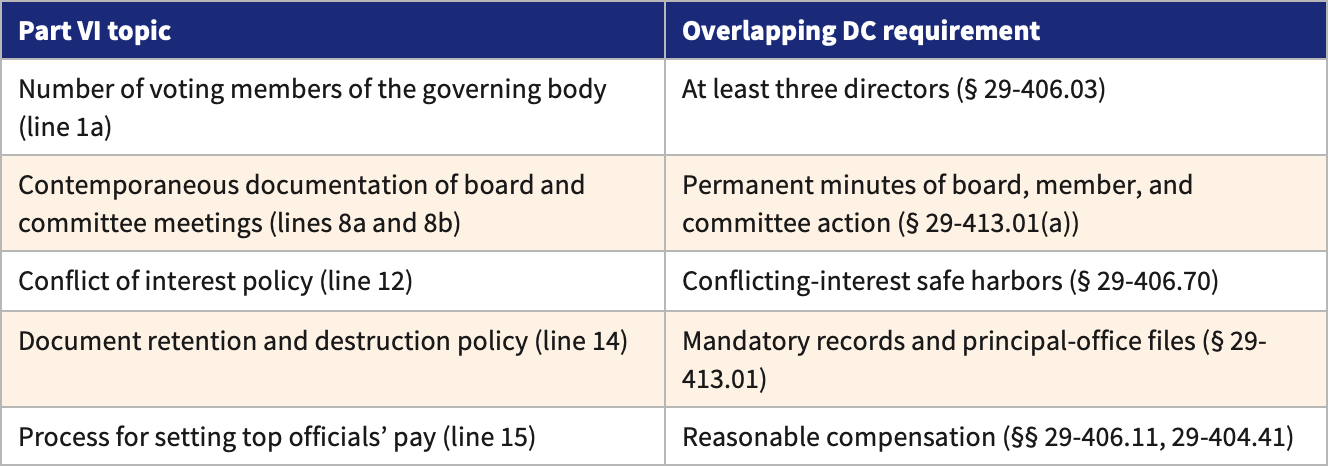
Form 990, Part VI. Many Part VI governance questions ask about practices federal tax law does not require, but several track DC mandates. Answering accurately and complying with DC law go together.
Form 990, Part VI and DC law (jurisdiction: DC)
Enforcement
DC enforcement runs through a closed list of court actions, and the Attorney General plays a standing role for charitable corporations. The Court of Appeals has called the Act’s list of challenges an exhaustive scheme that displaces free-standing equitable claims. OverDrive, Inc. v. Open eBook F., 288 A.3d 305 (D.C. 2023).
Attorney General. For charitable corporations, the Attorney General may compel a required meeting that has not been held for 30 days and may challenge acts beyond the corporation’s power. D.C. Code §§ 29-401.21(a), 29-403.04(b). The Attorney General also has broader authority against any nonprofit. On specified grounds – including fraudulently obtained articles, abuse of authority, and action contrary to nonprofit purposes – the Attorney General may seek dissolution, receivership, a constructive trust on compensation paid to a director or officer, or other equitable relief. The Attorney General may also issue subpoenas before filing suit. § 29-412.20.
Members and directors. A member, director, or officer whose status or duties are affected may ask the Superior Court to determine the validity of a corporate action. If the bylaws provide a means of resolving the challenge, the court only enforces the bylaws. § 29-401.22. In OverDrive, a member’s challenge to a merger failed for that reason. A derivative suit may be brought by members holding at least 5 percent of the voting power or by 50 members, whichever is less. A director may also bring one. In either case, the plaintiff generally must make a written demand and wait 90 days unless an exception applies. §§ 29-411.02, 29-411.03. Members and directors may also seek judicial removal of a director. § 29-406.09. They may also seek judicial dissolution. § 29-412.20.
Notice to the Attorney General. When the nonprofit is a charitable corporation, a plaintiff must notify the Attorney General within 10 days of starting a contested-action or derivative proceeding. §§ 29-401.23, 29-411.09. The plaintiff must also give notice of a judicial removal proceeding. § 29-406.09(e).
What enforcement looks like. In Pub. Media Lab, Inc. v. District of Columbia, 276 A.3d 1 (D.C. 2022), the Attorney General sued a 501(c)(3) alleging, among other things, failures to hold board meetings, keep records, maintain the required officers, and follow the conflict rules, and sought dissolution and a constructive trust.
Practical Takeaways
Audit the bylaws against the mandatory rules. Confirm at least three directors, a quorum no lower than the statutory floor, two separate required officers, and a named records officer. Then confirm the bylaws state how directors are selected and removed, whether written consent is allowed, and who may amend the bylaws.
Build a paper trail for every board action. Send notice for each special meeting, calendar one annual notice for regular meetings, record dissents and abstentions in the minutes, file signed waivers and unanimous consents with the minutes, and keep the principal-office record set current.
Put protections in place before a dispute. Confirm that liability insurance meets the § 29-406.90 limits, check whether the articles contain an exculpation provision if the organization is not a charitable corporation, and adopt indemnification and advancement provisions in the bylaws now.
Calendar the filings and screen the risky transactions. Track the April 1 biennial report, the registered agent, and solicitation registration. Route any transaction involving a director or officer through disinterested-director approval with the disclosure recorded in the minutes, and check any loan to an insider against the six statutory exceptions.
Conclusion
Good governance requires more than adopting a standard set of bylaws. A DC nonprofit must identify the rules it cannot change, make deliberate choices where the law allows flexibility, and maintain records showing that the board followed both the statute and its own governing documents. The practical test is simple: would the organization’s documents and actual practices hold up if someone challenged a vote, transaction, or director protection?
Alex Booker is the Managing Partner of Commonlight Legal LLP, a boutique law firm serving nonprofits in Massachusetts, Washington DC, New York, and Connecticut. He advises nonprofit boards and executive directors on employment law, governance, and compliance.
Before founding Commonlight, Alex served as an Attorney Advisor at the U.S. Department of Education's Office of General Counsel, adjudicated federal employment cases at the U.S. Merit Systems Protection Board, and litigated whistleblower and civil rights matters on behalf of employees at a DC plaintiff-side employment firm. Earlier in his career, he served as Research Director for a Massachusetts Joint Legislative Committee. Alex is admitted to practice in Massachusetts and Washington, DC.
This article is for general informational purposes only and does not constitute legal advice. Reading this article does not create an attorney-client relationship. For advice specific to your organization's situation, contact Commonlight Legal LLP.