
Direct vs. Grassroots Lobbying: What Counts, What It Costs
When I worked for a State Representative in Massachusetts, constituents would sometimes offer to buy lunch for the office. We would joke that we had to go somewhere where they could feed all of us for under $50, because Massachusetts gift rules prohibit giving legislators anything valued at $50 or more if it is connected to their official position or an official act. In practice, my boss always paid. But the exchange captured something executive directors know well: in public-policy work, good intentions do not answer the compliance question. The risk often turns on which rule applies, which threshold has been crossed, and whether the organization spotted the issue before acting.
The line the IRS actually draws
Federal tax law splits lobbying into two categories, and the split matters because each is measured, capped, and reported differently. Under Treasury Regulation § 56.4911-2, a direct lobbying communication is one made (1) to a legislator, legislative staffer, or another government official who may help formulate legislation, and (2) does two things: (a) it refers to specific legislation, and (b) it reflects a view on that legislation.
A grassroots lobbying communication shares both of those elements but adds a third. To count as grassroots lobbying, a communication to the general public must (1) refer to specific legislation, (2) reflect a view on it, and (3) encourage the recipient to take action. That third element, the call to action, is the entire distinction. A newsletter that praises a pending bill and urges its enactment is not grassroots lobbying if it stops there. The same newsletter becomes grassroots lobbying the moment it adds “write or call your senator.”
The regulation defines “encourages action” narrowly, through four categories:
(1) telling the reader to contact a legislator,
(2) supplying a legislator's contact information,
(3) providing a petition or postcard for the reader to send, or
(4) naming a specific legislator as opposing, undecided on, or otherwise positioned on the bill.
The first three “directly encourage” action and can never qualify for the nonpartisan-analysis exception. The fourth, naming a legislator's position without urging contact, only “encourages” action and can sometimes still qualify as nonpartisan analysis. For an executive director reviewing a draft advocacy piece, the practical point is simple: naming where legislators stand is not the same as telling readers to call them. A piece that lists how each committee member is likely to vote reads differently to the IRS than one that lists their vote and tells the reader to call.
One trap worth flagging separately: paid mass-media advertising in the two weeks before a legislative vote on a highly publicized bill is presumed to be grassroots lobbying if it takes a position on the bill's general subject, even without an explicit call to action. The presumption is rebuttable, but the burden sits with the organization to show the ad ran in the ordinary course of business or that its timing had nothing to do with the vote.
Two ways to measure “how much is too much”
Every 501(c)(3) is subject to a lobbying limit by default. The statute says exemption depends on “no substantial part” of the organization's activities being devoted to influencing legislation, but the regulation and the courts have never fixed a percentage. Litigated cases offer rough benchmarks rather than a bright line: activity under roughly 5% of an organization's time and effort has been found insubstantial, while activity in the 16.6% to 20.5% range of expenditures has been found substantial. Courts have expressly rejected a mechanical percentage test, so these figures are reference points, not safe harbors. That means the default rule is hard to manage because it depends on overall facts, not a clean annual budget number.
An eligible public charity can opt out of that facts-and-circumstances uncertainty by electing the § 501(h) expenditure test. The election is made on Form 5768, is retroactive to the beginning of the filing year, and continues automatically until revoked. Revocation, by contrast, is prospective only, effective the year after the notice is filed, which means an organization cannot elect out of 501(h) mid-year the way it can elect into it. Churches and their integrated auxiliaries cannot elect; private foundations and § 509(a)(4) organizations are separately ineligible.
Once elected, the vague substantiality inquiry is replaced by a sliding-scale dollar limit tied to the organization's exempt-purpose expenditures. In plain terms, the larger the charity's exempt-purpose budget, the larger its permitted lobbying budget, subject to the overall statutory cap:
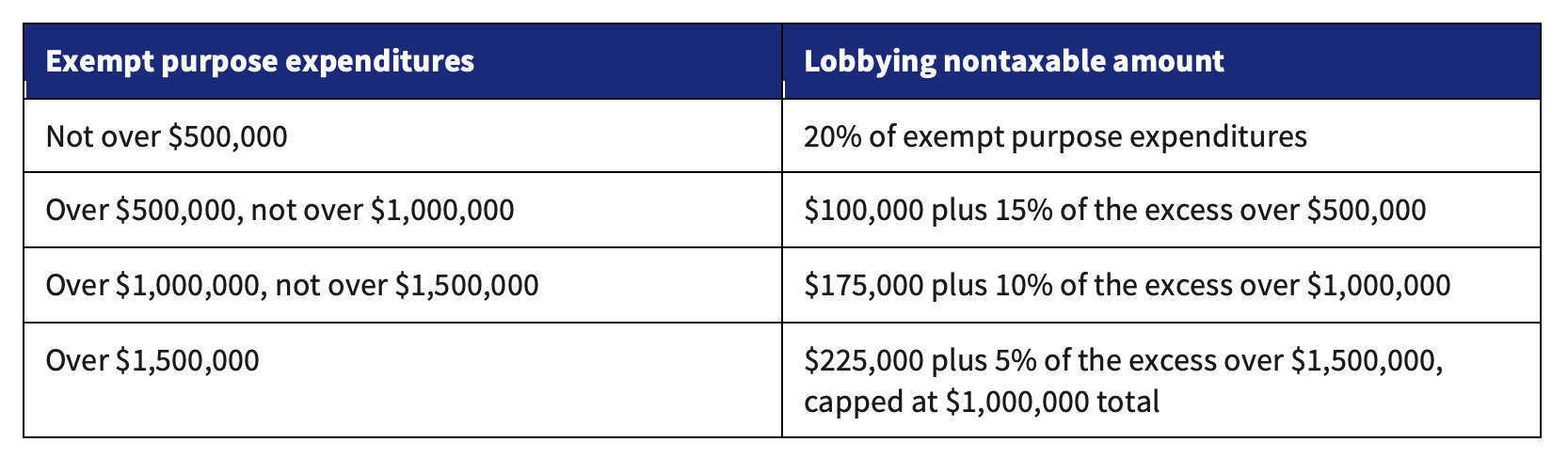
Within that overall number sits a sublimit: grassroots lobbying may not exceed 25% of the lobbying nontaxable amount. A charity with a $1,000,000 lobbying cap can spend no more than $250,000 of it on grassroots activity, even if its total lobbying stays under the overall number. Because the excise tax discussed below applies to the greater of the two overages, an organization can trigger tax by blowing through the grassroots quarter alone.
CT, DC, MA & NY: registering separately from the federal question
None of our firm’s four jurisdictions uses the IRC's direct/grassroots line as its own registration test. Each state, and DC, asks a different question. That means getting the federal classification right does not tell an executive director whether a state filing is due.
Connecticut.
The Code of Ethics for Lobbyists, Conn. Gen. Stat. §§ 1-91 et seq., is the outlier among the four: it is the only one that expressly reaches grassroots activity, because “lobbying” is defined to include soliciting others to communicate with officials, not just communicating directly. Registration triggers at $3,000 in a calendar year, measured separately for “client lobbyists” (the organization funding the effort) and “communicator lobbyists” (whoever does the actual communicating, with the threshold applied per client for retained lobbyists). There is no blanket nonprofit exemption; the available relief is activity-based, such as a carve-out for uncompensated testimony-only participation or under-five-hour efforts.
DC.
The DC Government Ethics Act, D.C. Code § 1-1161.01 et seq., ties registration to a single monetary trigger: $250 or more received or expended for lobbying in any rolling three-consecutive-month period, aggregated across all sources. There is no hours-based test. DC's definition of “lobbying” reaches only direct communication with a DC legislative or executive official, and it expressly excludes mass-media and membership communications, so DC tracks the federal Lobbying Disclosure Act's direct-contact orientation, not the IRC's grassroots category. A 501(c)(3)'s public-education campaign generally sits outside DC's registration trigger for that reason alone. The only nonprofit-specific relief is a reduced $100 registration fee (versus the standard $350) for a lobbyist working solely for nonprofit clients; it is a fee discount, not an exemption from registering.
Massachusetts.
Massachusetts defines “legislative agent” and “executive agent” around at least one lobbying communication with a government employee, combined with a two-part incidental-activity presumption: a person is presumed not to need to register only if they lobby 25 hours or fewer and receive less than $2,500 in a reporting period. M.G.L. c. 3, §§ 39-50. Cross either number and the presumption fails. Massachusetts, like DC, has no separate grassroots category; a salaried employee whose duties regularly include lobbying is captured regardless of compensation received specifically for it. The only nonprofit-specific relief is a discretionary fee waiver available to not-for-profit clients or lobbyist entities that register to represent nonprofits exclusively.
New York.
The Lobbying Act, N.Y. Legis. Law art. 1-A, takes the broadest approach of the four: it defines lobbying by the governmental outcome a person attempts to influence, not by the mechanism used to influence it, which is language broad enough on its face to reach indirect and grassroots efforts under the same single standard rather than a separate one. Registration is not required below $5,000 in combined compensation and expenses in a year, computed cumulatively across all lobbying activity. Beyond initial registration, New York requires ongoing filings: bi-monthly reports from lobbyists and semi-annual reports from clients.
Across all four, the pattern is the same: state registration is a separate question from federal expenditure classification, answered by a different definition and a different dollar (or hours) threshold, and none of them will tell you whether you have a 501(h) problem.
Where the real risk sits: allocation, not doctrine
Two operational issues cause more trouble than the definitions themselves.
Cost allocation.
For a 501(h) elector, a lobbying communication's cost is not just postage and printing. Treasury Regulation § 56.4911-3 also requires the organization to count staff compensation and an allocable share of overhead attributable to the communication, along with research, drafting, and mailing costs. If one communication serves both lobbying and non-lobbying purposes, the allocation rule depends on the audience. For non-member communications, every part on the “same specific subject” as the lobbying message counts, not just the sentence containing the ask. For member communications, the organization must make a reasonable allocation, and the regulation is explicit that isolating only the call-to-action sentence is not reasonable. If a single communication mixes direct and grassroots elements, it defaults to grassroots treatment unless the organization can show a primarily direct purpose. Because the grassroots sublimit is only a quarter of the overall cap, that default matters. Leaving staff time and overhead off the ledger, or treating a mixed communication as direct without support, is the common way a compliant-looking program turns out not to be.
Coalition and sign-on activity.
Joining a coalition letter, petition, or joint sign-on communication can create lobbying activity for a signatory 501(c)(3) when the underlying communication refers to and reflects a view on specific legislation. The classification follows the content and audience of the communication: a letter to legislators is direct lobbying, while a public sign-on urging the public to contact officials is grassroots lobbying. What changes from one coalition posture to another is not whether the activity counts, but how much expenditure is attributed to the organization. An organization that drafts the letter bears its full preparation costs, including research, drafting, review, and allocable overhead. An organization that co-signs and contributes funds bears its own incremental costs plus whatever it pays the coalition, if that payment is earmarked for lobbying; earmarked transfers for lobbying default to grassroots treatment absent proof otherwise. An organization that merely lends its name without paying anything has still taken a position in the organization's name, which is “action on legislative issues” under the regulation, but it may have little or no measurable expenditure if it spent nothing to develop or fund the piece. One useful protection remains: ordinary, unrestricted membership dues paid to a coalition that is itself a § 501(c)(3), and not earmarked for lobbying, are not lobbying expenditures. Coalition membership by itself also does not create an affiliated group for aggregation purposes; that requires actual control through interlocking boards or governing documents, which a voluntary coalition typically lacks.
What it actually costs to get it wrong
The consequences depend on which federal regime applies. That distinction matters because the two systems are mutually exclusive: a 501(h) elector faces one set of consequences, while a non-elector faces another.
A 501(h) elector that exceeds its nontaxable amount owes a 25% excise tax under § 4911 on the excess, measured as the greater of the overall overage or the grassroots-sublimit overage. That tax does not, by itself, cost the organization its exemption. Exemption is denied only if the organization “normally” exceeds 150% of its ceiling, a test applied over a rolling four-year base-year average, not a single bad year, with a transition rule protecting an organization's first three years after a new election.
A non-elector faces a different and, in one sense, blunter regime. If a substantial part of its activities becomes lobbying under the facts-and-circumstances test, it loses exemption outright under the “action organization” rule, with no dollar cushion to fall back on. A non-elector that loses exemption for lobbying then faces a separate 5% excise tax on the organization under § 4912, plus a separate 5% tax on any organization manager who knowingly and willfully agreed to the disqualifying expenditures (absent reasonable cause). Section 4912 by its own terms does not reach 501(h) electors, churches, or private foundations, which confirms it as the non-elector's exposure specifically.
Either way, the activity has to be reported. Schedule C to Form 990 splits along the same line: electors complete Part II-A with the § 4911 dollar figures, current year plus the base-year averaging columns; non-electors complete Part II-B with a narrative description of lobbying activity and its associated cost, consistent with the facts-and-circumstances standard that governs them.
Practical takeaways
1. If your organization is eligible, make the 501(h) election. Form 5768 is a one-time, low-cost filing that trades an open-ended substantiality standard for a defined dollar budget, and the election is retroactive to the start of the filing year.
2. Load staff time and overhead onto your lobbying figures as you go, not at year-end, and never isolate only the “ask” sentence when allocating a mixed-purpose communication. That is the specific pattern the regulation calls out as unreasonable.
3. Decide your posture before signing a coalition letter — drafting it, co-signing with an earmarked contribution, or lending your name for free — because each carries a different expenditure exposure even though all three count as lobbying activity attributable to you.
4. Confirm CT, DC, MA, and NY registration duties independently of your federal classification. None of the four states uses the IRC's direct/grassroots test, and a program that stays well inside your 501(h) grassroots sublimit can still trigger a state filing you weren't tracking.
5. Reconcile your Schedule C reporting against your internal allocation records before filing, since Part II-A's base-year averaging in particular depends on figures being consistent year over year.
Conclusion
The lunch joke was easy because the line was memorable: stay below $50. Lobbying compliance does not work that neatly. For an executive director, the challenge is that the same advocacy campaign can sit in different buckets at the same time: direct lobbying for federal tax purposes, public education outside a state registration law, grassroots lobbying because of one added call to action, or state-reportable activity because a dollar or hours threshold has quietly been crossed.
The practical answer is not to avoid advocacy. It is to build a review habit before the campaign launches: identify the audience, confirm whether the communication refers to and takes a position on specific legislation, flag any call to action, count the full cost of the work, and check state registration separately from the federal tax analysis. That is what lets a nonprofit speak on policy issues without discovering, after the fact, that the compliance problem was hiding in the classification.
This article is for general informational purposes only and does not constitute legal advice. Reading this article does not create an attorney-client relationship. For advice specific to your organization's situation, contact Commonlight Legal LLP.
Alex Booker is the Managing Partner of Commonlight Legal LLP, a boutique law firm serving nonprofits in Massachusetts, DC, New York, and Connecticut. He advises nonprofit boards and executive directors on advocacy compliance, employment law, and governance.
Before founding Commonlight, Alex served as an Attorney Advisor in the U.S. Department of Education's Office of General Counsel, where he oversaw a portfolio of federal legislation and coordinated policy positions across agencies — experience that shapes how he advises nonprofits navigating the boundary between mission-driven advocacy and legal compliance. He is admitted to practice in Massachusetts and Washington, DC.